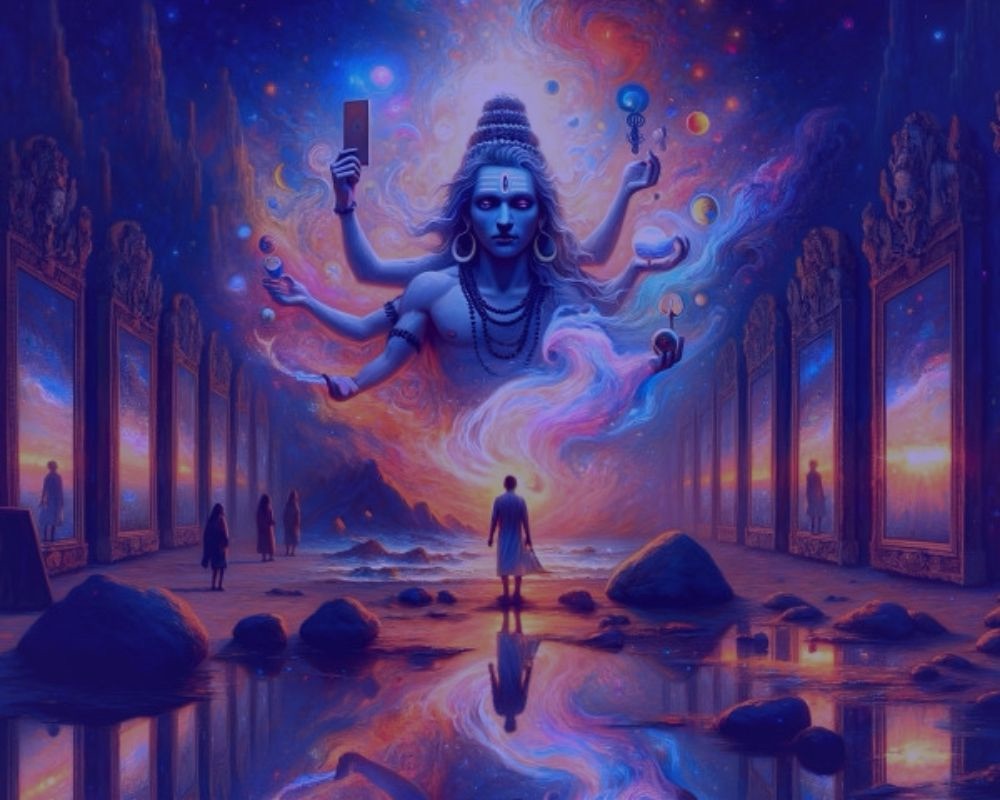
There are many beautiful and important concepts about the mechanisms of the universe and ourselves. Like the correlation between microcosm and macrocosm, the three gunas, polarities, the 36 tattvas, the 7 chakras, and many more.
In this article, we want to look at three very important principles, especially teached in buddhism.
- Anicca (Impermanance)
- Dukkha (Unsatisfactoriness)
- Anatta (Not-Self)
Anicca (Impermanence)
Everything in existence is in motion — arising, transforming, and dissolving. Nothing, not even the most radiant joy or deepest pain, remains fixed for long. This understanding of impermanence is not meant to make us sad, but free.
When we see that all things are transient — our thoughts, bodies, relationships, and even identities — we stop clinging to them as sources of lasting security. Life becomes a dance of continuous change, where beauty lies precisely in its fleeting nature.
To truly see impermanence is to touch eternity, because behind the flow of appearances, there is the witnessing consciousness that never changes. Recognizing this difference between what changes and what watches change is a doorway to liberation.
Dukkha (Unsatisfactoriness)
Because everything is impermanent, nothing conditioned can provide us with lasting fulfillment. This is the essence of dukkha — the subtle restlessness that runs through all experience when we look for permanence in the impermanent.
We chase pleasures, achievements, recognition, or love, believing they will complete us. Yet each one fades, leaving behind a taste of incompleteness. The more we cling, the more we suffer.
But dukkha is not a pessimistic view — it’s a compassionate invitation to seek deeper truth. It teaches us to redirect our longing from outer impermanent forms toward the unconditioned — that which is beyond birth and death. Once we stop demanding from life what it cannot give, we begin to experience a quiet joy that doesn’t depend on circumstances.
Anatta (Not-Self)
The third principle — anatta — points to perhaps the most subtle truth of all: that there is no fixed, separate self behind our experience. What we call “I” is a flowing process — sensations, perceptions, thoughts, and feelings constantly arising and dissolving, just like waves on the ocean.
This insight can at first feel unsettling, because our mind is so accustomed to identifying with stories and roles. Yet when we look deeply, we find that this sense of “I” cannot be found anywhere — it is empty of solidity, yet full of awareness.
To realize anatta is to awaken from the dream of separation. Life still continues — the body breathes, the world moves — but everything becomes lighter, freer, more spacious. We realize that we were never a separate drop struggling in the sea, but the ocean itself playing for a while as a wave.
Conclusion
These three truths — impermanence, unsatisfactoriness, and not-self — form the foundation of deep wisdom. They are not meant to make us detached or cold, but to reveal a gentler, more truthful way of being. When we see clearly that everything changes, that grasping brings suffering, and that there is no solid “me” to protect, the heart naturally relaxes.
Then love flows more freely, compassion deepens, and we begin to live from the spaciousness of awareness itself — serene in the flow of change, resting in the timeless.